
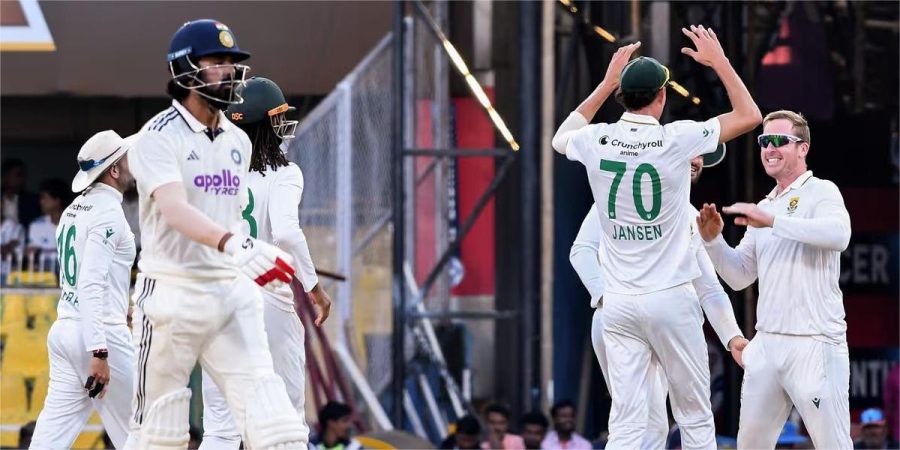
From “Ek Chakke ne World Cup Nahi Jitaya” to “I am the same guy under whom we won Champions Trophy & Asia Cup” – these lines have trended across social media platforms after India’s dismal performance against the Proteas at home.
Apparently, we are now breaking long-standing records – just not the ones we’d like. For the first time in 66 years, India lost Five Test matches in the span of Seven at home. That’s just one amongst many other unwanted milestones. And in the middle of all this, people are demanding Gautam Gambhir’s head on a platter or blaming the players for lacking a fighting spirit.
So, who’s really at fault?
In my humble opinion, Gambhir isn’t the coach Indian Cricket Team needed at this stage. As a player, yes, his grit was unquestionable, and right next to the great MS Dhoni (MSD), he deserves immense credit for the T20 and 50-over World Cup victories. But those credentials don’t automatically translate into being a good Coach. I genuinely feel he was rushed into the head coach role purely based on his IPL success.
The IPL is a completely different ecosystem. Most IPL teams are filled with young players who rarely challenge the coach’s authority, and the style of cricket itself is different. A Coach’s role in the IPL is more hands-on, short-term, and situational. Transitioning from IPL to T20 internationals might still be manageable, but Test cricket is an altogether different battleground.
From a technical and preparatory perspective, a Test Coach cannot simply field a team based on instinct. He must project five days ahead of assessing which players give the best chance for a win, analysing how the pitch might behave from Day 1 to Day 5, and understanding how each player mentally and technically handles the long format. Test cricket is considered the ultimate examination of a player’s complete skill set because it spans up to five days! It tests technique, mental fortitude, tactical depth, and physical endurance like no other format. And this is where a Coach’s true understanding of his players comes into play.
MSD excelled in this area. He knew his players abilities and placed them in situations where they had the best chances to succeed. He was a street-smart captain. Then came the Virat Kohli era, where I felt Ravi Shastri fulfilled the exact role a top-level coach should: motivating, reinforcing mental resilience, and creating a sense of belonging. Virat, as Captain, gave his heart every single time, and it showed in the team’s energy. Young or experienced, everyone fed off that intensity. And then under Rahul Dravid, India was the second-best team in Test cricket & WTC finalists
Gambhir, inherited a world-class side. One that held the No. 1 Test ranking for years under Shastri and WTC Finalist under Dravid, one that had conquered Australia in their own backyard. From that to losing Test series against New Zealand and South Africa at home is alarming for all the Indian cricket supporters. Yet while former cricketers, social-media experts, and analysts are busy blaming either Gambhir or the players for lacking application and fight, hardly anyone is questioning the elephant in the room – BCCI.
Why isn’t anyone asking how a team that dominated Test cricket for years suddenly looks clueless?
I genuinely believe there isn’t a single individual to blame. But when you look at India losing 3 – 0 to New Zealand at home on turning tracks and then suddenly demanding a rank turner in Kolkata, it’s hard to ignore that Gambhir, as coach, may have misread his own players’ ability to handle spin. That leads to a much bigger question – why has playing spin become such a challenge for cricketers who grew up on turning tracks?
For me, the answer points back to the BCCI.
I believe the BCCI must bear accountability. Their obsession with flat pitches, curated for sixes and fours in ODIs and T20s purely for entertainment and financial gain, has altered the natural rhythm of our batsmen. Playing continuously on such surfaces makes run-making easier, yes, but it leaves players exposed when confronted with bowler-friendly conditions. It’s no surprise they get found out. And that is exactly what we’re seeing now.
Critics often say players don’t do well because they don’t play enough domestic cricket. I disagree. It’s not a lack of match practice – it’s a lack of rhythm. Batting is a game of flow and mindset. You can’t suddenly flip a switch and expect players to adjust to five days of grinding cricket. Even professionals need time, preparation, and adaptation.
It’s on the Cricket Board to recognise the importance of Test cricket for the future of the sport. T20 is fine – it’s meant to be explosive. But ODIs need to return to being a contest between bat and ball, not festivals of flat pitches. And India desperately needs more Test cricket at home if we want to preserve the essence of the game. T20’s adrenaline rush will eventually fade. Test cricket is what needs saving.
You can’t organise a tour with 2 Tests, 3 ODIs, and 5 T20s and claim you’re doing what’s best for the gentlemen’s game. Indian cricket has always risen, whenever we have found hurdles, we have reflected and rebuilt with purpose. This moment is no different. The losses hurt, yes, but they also remind us of what truly matters – grit, patience, strategy, and the beauty of Test Cricket.
By
Ian Arshad Masih (Former Ranji Trophy Player – U.P.)
Sr. Sports Consultant
Crayons Academy for Skills Excellence